

Preface
In recent years, European countries like the UK, France, and Germany, along with US allies such as Australia and Canada, have notably increased their military presence in the Western Pacific region, including the South China Sea, East China Sea, Sea of Japan, and the Philippine Sea. Among various underlying motives, the most prominent view is that, against the backdrop of intensified US-China strategic competition, their deployments and activities in the region are meant to align with the US Indo-Pacific strategy and its competition with China.
On a broader scale, the Western Pacific is experiencing increasing prosperity alongside a rise in frequent geopolitical hotspots. As the South China Sea and Taiwan Strait become “trendy spots”, for Western countries that are either unsatisfied with exerting influence solely within their own regions or have imperial and colonial traditions, strengthening their presence in the Western Pacific is a significant measure to project global influence and uphold the “rules-based international order”. Beyond symbolic gains, there are tangible benefits: the substantial enhancement of political, economic, and military ties with Asia-Pacific countries through military activities and presence. Specifically, the considerations of each extra-regional country vary greatly.
However, compared to the US military, the military activities of these countries in the Western Pacific share certain commonalities: they have yet to establish regular deployments, lack robust operational capabilities, and are primarily strategic and diplomatic in nature. As they do not pose significant military threats to regional countries, it is crucial not to overstate their impact on the security dynamics in the region. However, on a tactical and operational level, some extra-regional countries like Australia and Canada have conducted military activities that are sometimes very aggressive and unprofessional, resulting in frequent unsafe maritime and aerial encounters with regional military forces. Consequently, the impact of these countries’ military presence and activities on regional security dynamics cannot be overlooked, and oversimplifying this would be imprudent.
In light of relevant insights, we have compiled and released this annual report to systematically review and comprehensively analyze the military activities of non-US extra-regional countries in the Western Pacific. The goal is to furnish the audience with a more complete and objective understanding of these activities and their implications for regional security dynamics.
Director of SCSPI Hu Bo

Key Findings
I. Overview
1. Warship Activities
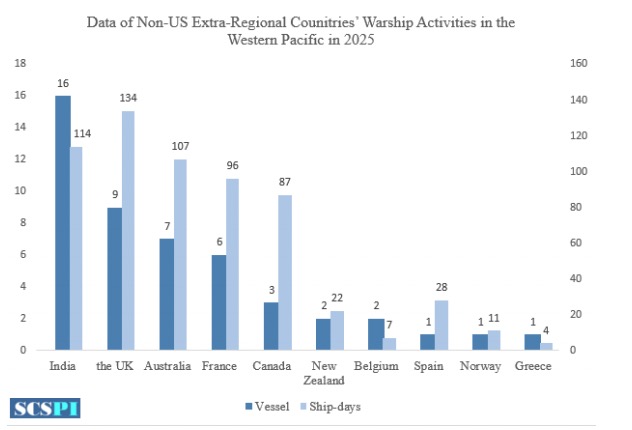
In 2025, according to incomplete statistics, approximately 200 warships from 18 extra-regional countries operated in the Western Pacific, totaling nearly 10,000 ship-days of naval presence. The US Navy accounted for 109 ships and 9,088 ship-days, while other countries, primarily from Europe, Oceania, and Canada, contributed 48 ships and 610 ship-days, averaging about 2 ships per day.
2. Aircraft Activities
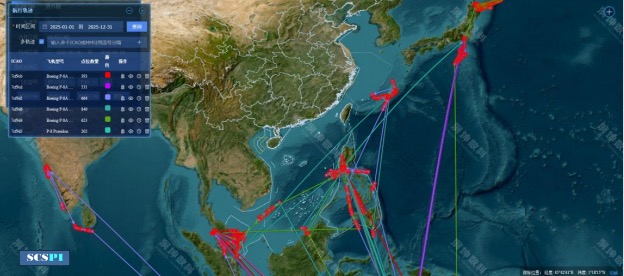
In 2025, according to incomplete statistics, there were over 20,000 sorties of aircraft sent by extra-regional countries in the Western Pacific, including fighters, helicopters, transport aircraft, reconnaissance aircraft, tankers, and bombers. Most were US sorties, while other extra-regional countries, such as Australia, Canada, and India, combined approximately 1,500 sorties.
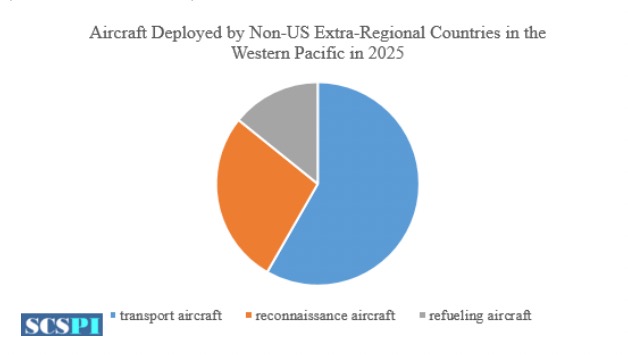
Non-US sorties were mostly transport aircraft, helicopters, reconnaissance aircraft, airborne early warning aircraft, and refueling aircraft, among which transport ones ranked top with nearly 900 flights (over 50% of the total).
3. Special Deployments
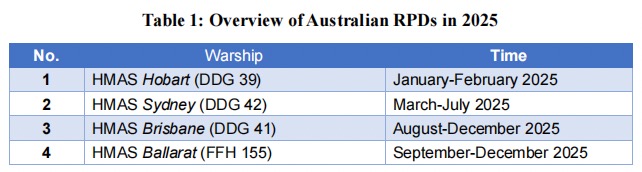
In 2025, the military activities of these extra-regional countries in the Western Pacific were mostly temporary deployments, participation in drills, or transit and overflight operations, with year-round rotational regular deployments primarily limited to Australia. Due to military resources and strategic priorities, countries like Canada and India deployed limited forces to this region through specific actions annually, while the UK and France opted for temporary large-scale or permanent small-scale surveillance vessel deployments with limited scale and frequency.
II. Main Characteristics
1. Strengthened Deployment of Large Platforms
Highlighting military presence through deployments of large platforms or task groups has become the main tactic for traditional maritime powers like the UK and France to increase visibility in the Western Pacific.
2. Normalized Declaratory Activities
Countries like the UK, France, Canada, and Australia do not have the concept or practice of FONOPs. Nevertheless, in recent years, these countries have frequently undertaken similar declaratory activities in the Western Pacific, citing tensions in the Taiwan Strait and the South China Sea as justification. In 2025, amid ongoing tensions in the Taiwan Strait, extra-regional navies from Australia, Canada, and the UK intensified their activities in the Western Pacific in the name of upholding navigation rights in international waters as per the United Nations Convention on the Law of the Sea (UNCLOS), showcasing military presence by transiting the Taiwan Strait or carrying out “freedom of navigation” activities in the South China Sea.
Statistics show that in 2025, apart from the US, 4 countries including Australia, Canada, the UK, and New Zealand deployed 6 warships to transit the Taiwan Strait 5 times, all accompanied by official public reports.
3. Increased Participation in Exercises and Drills
Compared to previous years, extra-regional countries escalated their involvement in large-scale military drills notably in the Western Pacific in 2025. Particularly, some European countries promoted interoperability and collective deterrence through dominating or participating in multilateral drills with larger scale and wider participation via CSG deployments.
III. Objectives
The military activities of extra-regional countries such as the UK, France, Canada, and Australia in the Western Pacific differ fundamentally from those of the US military. Most of them have neither substantive geopolitical conflicts with China, nor capabilities to mount a significant military challenge in the region.Apart from coordinating with US operations, their primary objectives are to serve diplomatic ends and to uphold the “rules-based international order.”
IV. Trends
Currently, considering the Russia-Ukraine War and disputes over Greenland, the Trans-Atlantic partnership is undergoing a profound realignment. With military resources severely stretched by geopolitical crises in the Middle East and other regions, extra-regional countries including the UK, France, Canada, and Australia are focusing on reevaluating and reestablishing their ties with China. However, it remains to be seen whether these factors could make them pragmatic and low-profile in consideration of their military presence and activities.
Please download PDF for full report.
SCSPI

With a view to maintaining and promoting the peace, stability and prosperity of the South China Sea, we launched the South China Sea Strategic Situation Probing Initiative (SCSPI). The Initiative aims to integrate intellectual resources and open source information worldwide and keep track of important actions and major policy changes of key stakeholders and other parties involved. It will provide professional data services and analysis reports to parties concerned, helping them keep competition under control, and seek partnerships.