
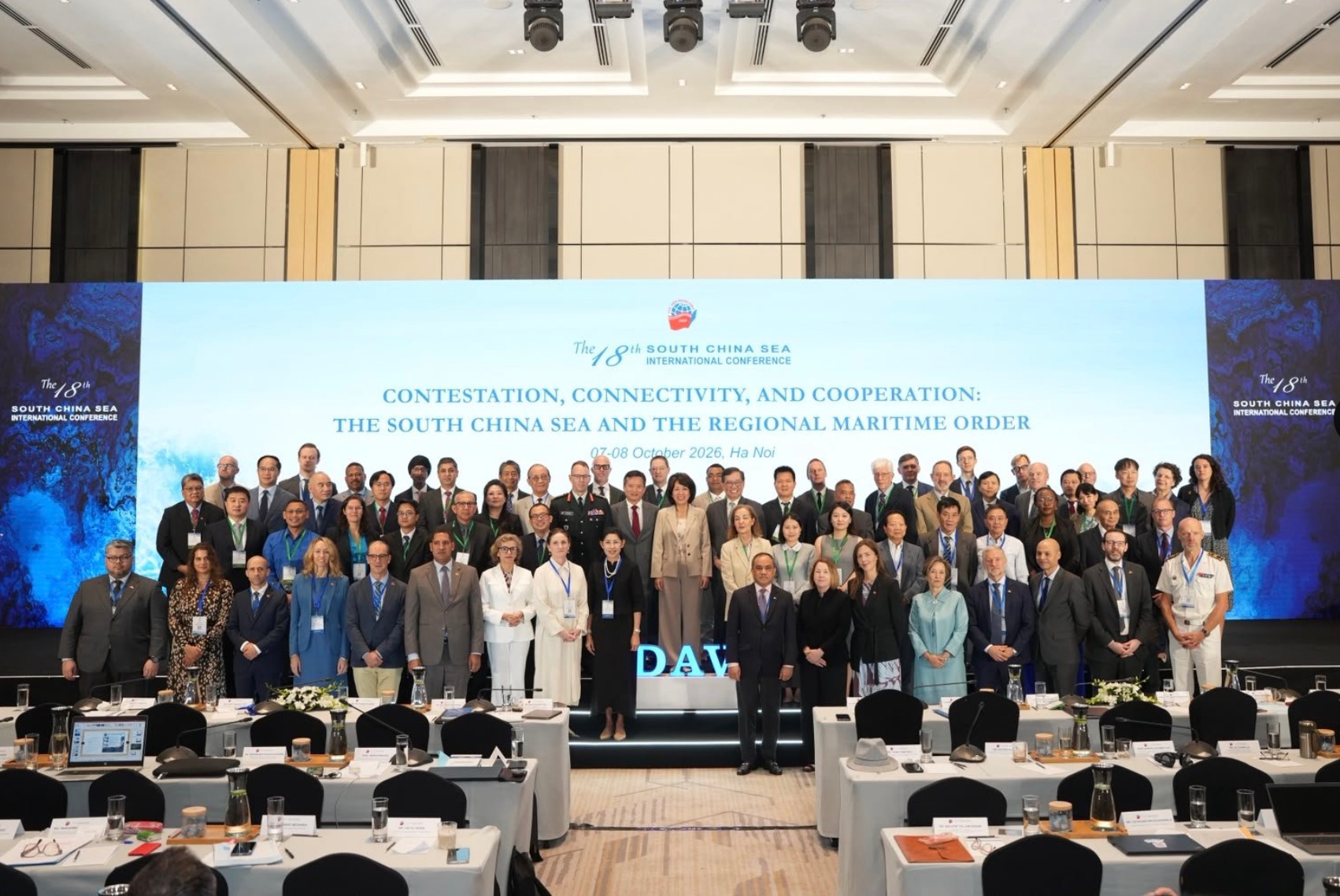
Editor's Note:On October 7th–8th, 2026, Hu Bo, director of SCSPI and Director of Center for Maritime Strategy at Peking University were invited to attend the 18th South China Sea International Conference hosted by the Diplomatic Academy of Vietnam in Hanoi, Vietnam. He delivered a keynote address titled “The Changing Balance of Power and Its Influence in the South China Sea.”

Thank you, Ambassador, and thank you for the invitation. And good morning, colleagues. To discuss the balance of power, we first need to review the power distribution in the South China Sea and beyond.
The Balance of Power Situation
Definitely, China and the United States are the two most capable and powerful actors in the South China Sea and beyond.
Since 2008 and 2009, the US has increased its military activities and presence in the South China Sea. The presence and activities of the US military in the South China Sea have doubled in ten years.
Every year, there are 10,000 sorties of military aircraft and almost 2,000 ship-days of warships operating in the South China Sea.
According to our observations, US military activities and presence in the South China Sea peaked around 2023. In the recent two or three years, some US military activities and presence have declined slightly. Anyway, the numbers are still very high. I think it will be difficult for the US to continue to increase its military activities and presence in the South China Sea.
After three decades of modernization, the Chinese military has made very historical achievement. Nowadays, the PLA's capabilities, in both quantitative and qualitative terms, can match those of the US military in the South China Sea and beyond.
Generally speaking, I think both sides have advantages and disadvantages in the South China Sea. Neither side can easily defeat the other.
Besides, other coast states of the South China Sea, for instance, Vietnam, Malaysia, and Indonesia, have also significantly improved their capabilities, especially the coast guards and law enforcement forces. Moreover, Southeast Asian countries have invested in A2/AD capabilities.
Their capabilities are not comparable to those of China and the US, but geography matters. Compared with the Pacific Ocean, the South China Sea is relatively small; in human terms, however, it remains vast. An area of 3.5 million square kilometers is very large for any actor. It is therefore misleading to suggest that China can and will control the South China Sea. No matter how many warships China and the US possess, I do not think either could control the entire South China Sea because of its geography. As to sea control, usually the most important thing is to control the checkpoints. In this sense, Malaysia, Indonesia, and Singapore, which are close to the Strait of Malacca, have a better position than China to control the South China Sea.
The third category of actors in the South China Sea consists of other extraregional powers. For instance, Australia, Canada, and European countries. Their military activities in the South China Sea have also increased significantly in recent years. But frankly speaking, their military significance is limited. Their deployments and activities in the South China Sea have greater political and diplomatic than military significance. From a military perspective, their activities and presence cannot alter the balance of power in the South China Sea.
Interactions and Intentions
The final point I want to share is the interactions among the different actors in the South China Sea and their intentions.
First, let us consider China-US strategic stability. The summit held in Beijing this May just used the term “constructive strategic stability”. It seems that the China-US relationship is in stabilizing. The most important and major consensus for both sides is that “we are competing, but we don't want to fight each other.”
The signal is very clear from both sides. Obviously, it's not a secret that both sides are preparing for the worst scenarios. However, they have made it very clear that they don't want to have a direct military confrontation or war, which may be the most major consensus for constructive strategic stability.
This kind of stabilization is not a short-term but a long-term process. It began not with Donald Trump's second term, but during the latter part of Joe Biden’s presidency. And also, it reflects the compromises and consensus after a prolonged competition since 2009, especially in the maritime domain.
After the San Francisco summit in November 2023, the two militaries have resumed all communication channels and dialogues, and both sides have shown self-restraints in their operations in the South China Sea and beyond. Nowadays, the two militaries have more than ten encounters a day in the South China Sea. But we have seen far fewer unsafe encounters. That's a positive improvement compared with the situation two or three years ago.
As for the South China Sea disputes, they remain generally controllable. Maritime disputes are a global phenomenon, they occur in the Arctic and elsewhere, as well as in the South China Sea. The South China Sea disputes can generally be controlled. Nowadays, the maritime disputes between China and Malaysia, as well as those between China and Vietnam, are relatively well-managed; the sole exception is the dispute between China and the Philippines. But sometimes I'm tired of talking about China-Philippines conflicts in the South China Sea. We should not allow disputes and conflicts between China and the Philippines to dominate ASEAN and regional agendas.
Finally, I want to share my understanding of China's intentions in the South China Sea. China's claims have remained highly consistent. It’s unprofessional to say that China uses the dashed line to claim the South China Sea. Actually, the dashed line just delineates the scope of China’s various claims within it. The dashed line itself is not a legal basis for China’s claims. The media frequently state that China uses the dashed line to claim 90% of the South China Sea. However, when it comes to academic and policy expressions, there should be some differences. China has repeatedly stated its four types of claims in the South China Sea: sovereignty over the four island groups, including Spratly Islands, Paracel Islands, Pratas Islands, and Macclesfield Bank and Scarborough Shoal, internal waters and territorial seas of these island groups, Exclusive Economic Zones and Continental Shelves of these island groups, and historic rights.
China's policy on the South China Sea disputes is also very consistent. Even now, Beijing continues to follow Deng Xiaoping’s principle of shelving disputes. China is keeping the status quo rather than changing it. Compared with twenty or thirty years ago, the only change is China's capability and resolve to defend its sovereignty and maritime rights.
Hu Bo

Hu Bo, Research Professor and Director of the Center for Maritime Strategy Studies, Peking University, and Director of SCSPI. His areas of specialization include maritime strategy, international security, and Chinese diplomacy. He has written three books and more than 40 journal articles and book chapters on topics related to China’s maritime strategy and policy. His most recent books published in Chinese are as follows: China’s Maritime Power in 2049 (Beijing, China Development Press, 2015); China’s Sea Power in the Post Mahan Era (Beijing, Ocean Press, 2018); and forthcoming: Chinese Maritime Power in the 21st Century (Routledge, 2019).